
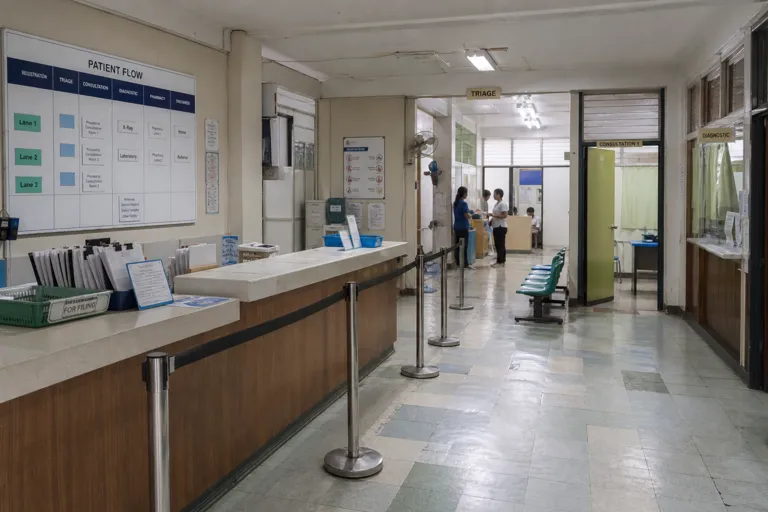
Universal coverage is not just a policy backdrop in the Philippines. It is changing how healthcare demand is recorded, reimbursed, and scaled. In the Philippines healthcare services market, providers converted public insurance, household payments, and private health-plan funding into care that amounted to about 157.2 million patient encounters in 2025, including 7.17 million inpatient admissions. Ken Research values this healthcare services market at USD 14,820 million in 2025 and projects it to reach USD 31,553 million by 2032, an 11.40% forecast CAGR, following an estimated 7.50% historical CAGR during 2020–2025. This is the context for a Philippines universal health care investment thesis: utilization is rising, but value is projected to expand faster than encounters as reimbursement, service complexity, and provider mix evolve.
Capacity and purchasing power remain clustered, which influences where private capital can scale fastest. In January 2024, the National Capital Region, CALABARZON, and Central Luzon contained 157, 233, and 197 hospitals, respectively, according to Ken Research. A related Ken Research summary also describes Metro Manila, Cebu, and Davao as dominant regions, with Metro Manila hosting advanced facilities and specialist concentrations, while Cebu and Davao function as hubs for the Visayas and Mindanao. These clusters matter commercially because referral flows come from provinces where advanced diagnostics and tertiary beds remain limited. For investors, this implies two parallel plays: densifying networks where demand is already formalizing and selectively expanding access points that capture referrals into diagnostics and higher-acuity services.
Where Investors Fit: Outpatient, Diagnostics, and Digital Rails
Ken Research expects profit pools to shift toward outpatient centers, diagnostics, dialysis, oncology, and digitally coordinated chronic care. The same research identifies outpatient and ambulatory care services as the dominant segment and fastest growing for 2025–2032. Another Ken Research summary highlights a shift from hospital-led to clinic-centric care, framed by chronic disease prevalence and demand for affordable outpatient solutions amid high out-of-pocket expenses. Investors can fit into this build-out by funding clinic networks that integrate labs, clinics, and tertiary hospitals to capture referrals and manage chronic pathways. However, Ken Research flags risks that capital must underwrite carefully, including PhilHealth fiscal pressure, workforce scarcity, and prolonged bed-capacity constraints.
Digital platforms are also becoming part of the scaling toolkit, especially where clinical capacity is constrained. Ken Research describes 114.9 million residents in 2023 and only 7.92 physicians per 10,000 people, supporting a strong economic case for telemedicine, triage, and remote monitoring. The Philippines digital health market is valued at USD 2.8 billion in 2025 and is projected to reach USD 6.1 billion by 2031, a 13.86% forecast CAGR, after a 16.95% historical CAGR during 2020–2025. Metro Manila represented about 40% of national telemedicine revenue in 2025, while Cebu and Davao are emerging as secondary deployment centers. Ken Research also notes that projected value assumes continued implementation of universal healthcare reforms and gradual adoption of standards-based health information exchange.
Investable infrastructure is not limited to telehealth. In AI-enabled healthcare, IMARC Group figures cited by Vocal Media place the Philippines AI in healthcare market at USD 194.85 million in 2025, projected to USD 1,441.56 million by 2034, with a 24.90% CAGR during 2026–2034. Vocal Media also reports government and corporate commitments tied to deployment, including a Department of Science and Technology allocation of more than PHP 2.6 billion for AI projects, Department of Health plans using AI to screen 12 million Filipinos for tuberculosis, and a PHP 7 billion AstraZeneca commitment to a Health Innovation Hub. Meanwhile, The Business Times reports that private equity and conglomerates are already scaling platforms, including ABC Impact taking a 16% minority stake in Ayala Healthcare, and that Makati Medical Center is owned by Metro Pacific Health, backed by KKR & Co, GIC, and MPIC. The opportunity is real, but public-private alignment is still described as vital for scale and efficiency.
What is driving the Philippines healthcare services market outlook?
Which regions concentrate hospital capacity in the Philippines?
Where are the key profit pools for investors emerging?
How does digital health support the universal care build-out?
What does a Philippines universal health care investment thesis focus on today?