Quick commerce is no longer a novelty in Southeast Asia. Momentum Works’ research cited by ACV Capital and Tech Collective estimates the region’s quick commerce sector generated US$7.3 billion in gross merchandise value (GMV) in 2025, equal to about 4.6% of the region’s e-commerce market. Yet it still accounts for less than 1% of total retail sales across Southeast Asia, which signals both an early-stage category and a fast-forming consumer habit for everyday needs. This is the tension brands must plan around: a channel that is still small in total retail, but strategically important because it changes how consumers buy groceries and essentials, and how retail availability is judged in real time.
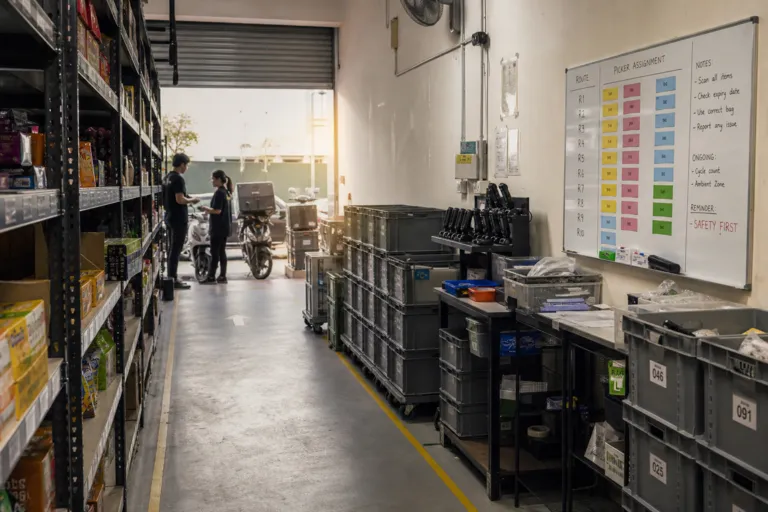
At the global level, 360iResearch frames quick commerce as on-demand retail built on compressed delivery windows, dense urban fulfillment networks, real-time inventory visibility, and mobile-first ordering. It notes that the operating model depends on hyperlocal execution across dark stores, micro-fulfillment centers, neighborhood hubs, and courier networks, supported by route optimization and demand forecasting. The same source highlights that success increasingly depends on operational discipline, inventory accuracy, unit economics, customer retention, and responsible delivery practices rather than speed alone. For brand teams, this changes what “distribution” means. It becomes a continuous availability problem, not a periodic shelf-reset problem, and it moves route-to-market conversations into dispatch reliability, substitution accuracy, and resolution of service issues.
What Changes in Brand Route-to-Market When Delivery Is Measured in Minutes
A practical lens comes from Thailand. Mordor Intelligence estimates Thailand’s quick commerce market at USD 0.59 billion in 2025, rising from USD 0.66 billion in 2026 to USD 1.12 billion by 2031 (11.25% CAGR, 2026–2031). In 2025, Grocery and Staples held 53.48% share, and 11–30 minute promises accounted for 56.25% share of market size. The same report notes Thailand recorded 4G population coverage at 98% and active mobile broadband subscriptions at 122 per 100 inhabitants, enabling app-led ordering and live dispatch. For brands building an ASEAN quick commerce route to market, the implication is clear: prioritize high-velocity packs, tight availability on core grocery and staples missions, and retailer or platform partners that can maintain dependable delivery windows in dense urban clusters.
The route-to-market playbook also has to reflect how platforms evolve. 360iResearch describes a shift from standalone instant delivery hubs to hybrid fulfillment networks combining stores, dark stores, partner merchants, and automated picking systems. It also flags growing scrutiny around courier classification, road safety, congestion, consumer data usage, and fair platform practices, alongside sustainability expectations such as route consolidation and improved cold-chain management. In parallel, Tech Collective notes competition may depend less on speed and more on operational efficiency, retailer partnerships, and ecosystem integration. Brands should respond by aligning trade terms, assortment, and replenishment with the fulfillment model in each city, while building processes to protect inventory accuracy and reduce out-of-stocks that directly hit conversion in mobile-first journeys.
Finally, quick commerce sits inside a broader digital path-to-purchase. Hashmeta reports that about 64% of Southeast Asian shoppers check brand social media pages before purchasing, and 58% seek recommendations from friends via messaging apps during consideration. It also reports that 47% purchase during live-stream sessions and 68% buy influencer-recommended products. That matters for route-to-market because demand creation and demand fulfillment are collapsing into the same screen. Brands that treat quick commerce as only a logistics add-on will miss the point. Winning distribution increasingly connects content, creator activity, and platform merchandising to real-time availability, so the consumer’s intent is captured at the moment it spikes and fulfilled through the best-positioned network.
How big is Southeast Asia’s quick commerce market according to Momentum Works?
If quick commerce is growing, why does it still matter for retail strategy now?
What does Thailand’s data suggest about fast-delivery category focus?
What operational capabilities should shape an ASEAN quick commerce route-to-market plan?