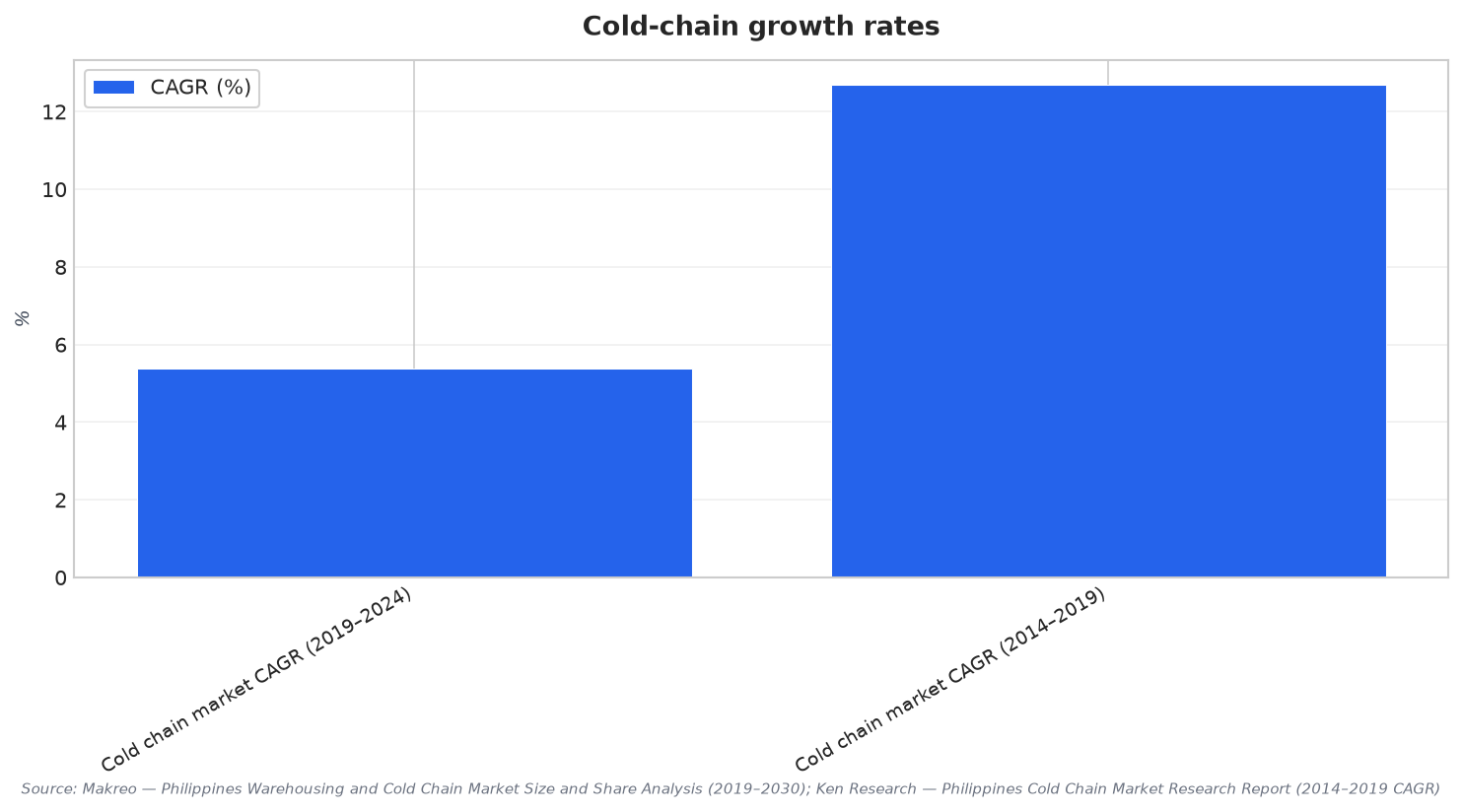
Cold-chain is no longer a niche add-on in Philippine supply chains. It is becoming a core capability for food distribution and pharmaceutical integrity, especially across an archipelago where handoffs between ports, trucks, and warehouses are unavoidable. Industry research points to steady expansion: the country’s cold storage market expanded at a 5.39% CAGR from 2019 to 2024, tied to rising investments in temperature-controlled warehousing for perishable goods, notably in food and beverage logistics. Another lens is the wider freight market, which Mordor Intelligence valued at USD 15.26 billion in 2025, with projections rising to USD 21.60 billion by 2031, highlighting how shipment volumes and service expectations are pulling cold capacity into strategic planning.
Demand signals are increasingly measurable. Makreo reports e-commerce accounted for 7.5% of total retail in 2023 and is forecast to reach 9.5% by 2028, driving retailers and logistics providers to invest in modern warehousing, including cold storage, to meet expectations for reliable fulfillment. Mordor adds that e-commerce gross merchandise value climbed to USD 21 billion in 2025 and that 73% of adult Filipinos shopped online, intensifying last-mile and faster replenishment cycles. Ken Research also flags food delivery momentum, citing that companies like Grab and Foodpanda reported a 30% year-on-year increase in orders. Together, these shifts translate into more time-sensitive baskets that include chilled and frozen items.
Where Cold Capacity Meets Connectivity Across Islands
The investment frontier is not only about adding refrigeration. It is about placing capacity where inter-island movement can stay within temperature limits. Nexdigm describes cold-chain infrastructure as concentrated around Metro Manila, Cebu, and Davao, where port connectivity and demand centers support high-volume refrigerated activity. The same report notes that refrigerated transportation services hold a dominant share because nationwide distribution requires reliable temperature-controlled delivery networks, including coordination of maritime and trucking legs between islands. On the freight side, road freight handled 67.45% of 2025 revenue in the Philippines, while sea and inland waterways controlled 58.20% of 2025 freight forwarding values, showing why cold-chain build-outs must account for both land and coastal routes.
Government programs are also shaping investable opportunities. Mordor’s ASEAN cold chain analysis reports the Philippines allocated PHP 3 billion in June 2025 for 99 facilities to address regional supply gaps for fruits, vegetables, and fisheries, tying food security budgets to post-harvest cold storage. Makreo further notes that cold-chain development is overseen by the Department of Transportation (DOTr) and backed by Official Development Assistance (ODA), with the aim to reduce agricultural spoilage and enhance infrastructure. It also cites major connectivity ambitions such as the planned Bataan–Cavite Interlink Bridge, estimated at USD 3.91 billion, and points to Build Build Build efforts that enhanced transport and logistics networks and increased warehouse capacity in 2024.
But the case for investing must include the cost side. Ken Research reports that energy expenses can account for up to 30% of total logistics costs in cold-chain operations, and that the average cost of maintaining a cold storage facility can reach PHP 1 million monthly, a barrier for small and medium enterprises. That is why scale, compliance, and network design matter. In the Philippines freight and logistics market, temperature-controlled capacity captured 8.41% of 2025 warehousing space and is set to grow at a 6.69% CAGR between 2026 and 2031, outpacing ambient facilities. For investors, the frontier is therefore not just more cold rooms, but smarter placement, transport integration, and operating models that can absorb high energy and compliance requirements while serving expanding retail and export-quality needs.
What is driving investment interest in Philippines cold chain logistics?
How big is the Philippines freight and logistics market in recent estimates?
How much warehousing space is temperature-controlled today, and what is its growth outlook?
What public funding is mentioned for new cold-chain facilities in the Philippines?
What cost pressures can limit cold-chain expansion?