The European Union’s Carbon Border Adjustment Mechanism is changing what it takes to sell into Europe. Under Regulation (EU) 2023/956, CBAM covers six sectors effective January 1, 2026: iron and steel, cement, aluminium, fertilizers, electricity, and hydrogen. Since January 2026, importers of products including steel, aluminium, cement, fertilisers and hydrogen have been required to comply with the mechanism. For ASEAN exporters, this is no longer only a trade topic. It is also a workforce and operations issue, because firms must measure embedded emissions, prepare carbon reports, and in many cases upgrade production processes to avoid losing competitiveness in the EU market.
Exposure varies by country and product mix. Malaysia, Indonesia and Vietnam are among the region’s leading exporters of iron, steel and aluminium to the EU, and failure to meet reporting requirements can reduce competitiveness. Trade linkages are already large in specific ASEAN partners: in 2023, India, Indonesia, and Vietnam together exported over USD 10 billion in aluminum, cement, fertilizer, and iron and steel to the EU. In the same year, Indonesia ranked 7th and Vietnam 20th in iron and steel exports to all markets, while Vietnam and Indonesia were the 2nd- and 10th-largest exporters of cement. These positions help explain why steel, cement, and aluminium sit at the center of ASEAN’s CBAM risk conversation.
Steel’s Carbon Lock-In Meets EU Compliance Reality
Steel is where CBAM exposure can become structural, not just administrative. Vietnam, Indonesia, and Malaysia expanded rapidly, with combined crude steel output rising from 14 million tonnes in 2015 to over 49 million tonnes in 2024. The same analysis reports weighted average emissions intensities ranging from 1.78 to 2.00 tCO₂ per tonne of crude steel, and highlights 68.7 million tonnes of new BF-BOF capacity announced or under construction, creating a 25–30 year carbon lock-in. Without robust Monitoring, Reporting and Verification systems and domestic carbon pricing, producers face the risk of punitive default values that can make EU exports uncompetitive regardless of actual performance.
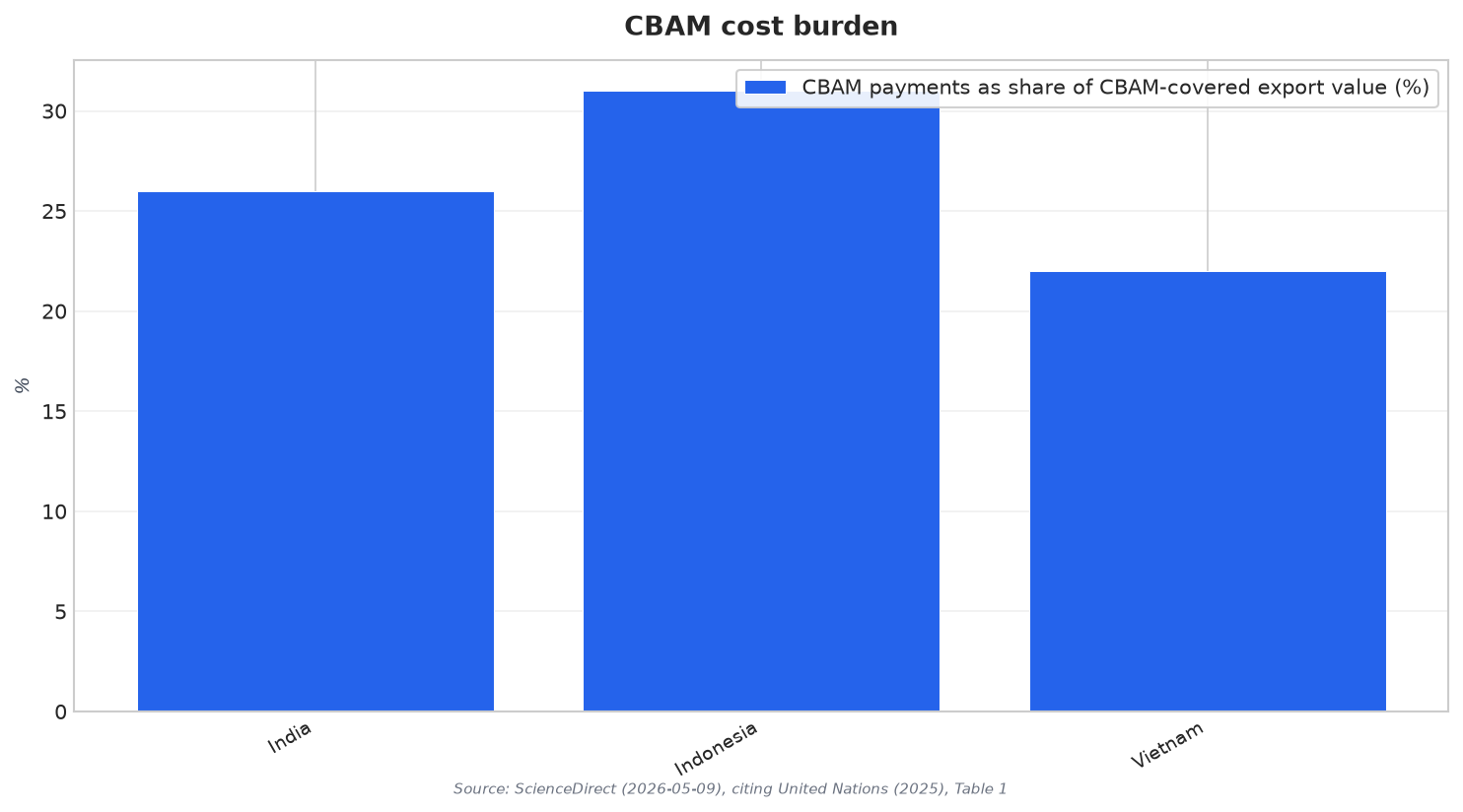
The CBAM compliance bill is also becoming easier to translate into financial terms. By 2026, CBAM certificate purchase requirements are imposed to cover the gap between the EU carbon price and that of the exporting country. One estimate puts potential annual CBAM payments for imports from Indonesia at USD 234 million, concentrated almost entirely in iron and steel (USD 226 million). In that same assessment, the payments represent 26%, 31%, and 22% of the value of CBAM-covered exports to the EU in 2023 for India, Indonesia, and Vietnam, respectively. These ratios help frame why ASEAN CBAM exposure exporters must treat emissions data quality as a commercial capability, not a back-office task.
Cement and aluminium bring different technical pressures. CBAM rules cover both direct and indirect emissions for cement, and cement has unavoidable CO2 emissions from limestone calcination; this chemical reaction accounts for approximately 60% of the sector’s carbon footprint. Aluminium is the only CBAM sector that covers perfluorocarbons alongside CO2, and scrap has zero embedded emissions under the regulation, creating compliance advantages for exporters with high recycled content. Early modelling for ASEAN-6 suggests the cement and iron and steel sectors are most sensitive to tariff adjustments, with projections that the Philippines could see export declines to the EU of 15% for cement and 11.6% for iron and steel; Thailand is projected to incur a cement export value loss of USD 1.5 million due to its larger export base. Across sectors, SMEs face greater challenges due to limited financial resources and technical expertise needed for reporting, widening the gap with larger firms.
What products are covered under the EU CBAM from January 1, 2026?
Which ASEAN countries are highlighted as leading exporters of iron, steel, and aluminium to the EU?
How large is the recent expansion in Vietnam-Indonesia-Malaysia steel output mentioned in the sources?
What is one estimate of annual CBAM payments tied to Indonesia’s exports to the EU?
How should ASEAN CBAM exposure exporters prioritize compliance work for steel, cement, and aluminium?