
The Philippines’ outsourcing story is no longer just a call center story. By 2026, the country’s industry is widely described as IT-BPM, reflecting a broader mix that includes customer service, software development, finance and accounting, healthcare administration, cybersecurity, engineering, analytics, and AI operations. This shift is happening while the sector stays large and resilient. Export revenues surpassed USD 40 billion in 2025, following USD 38 billion in 2024, and employment reached around 1.9 million workers in 2025. For many leaders, the bigger question is not whether the industry grows, but how it evolves as automation and digital transformation reshape what global clients buy.
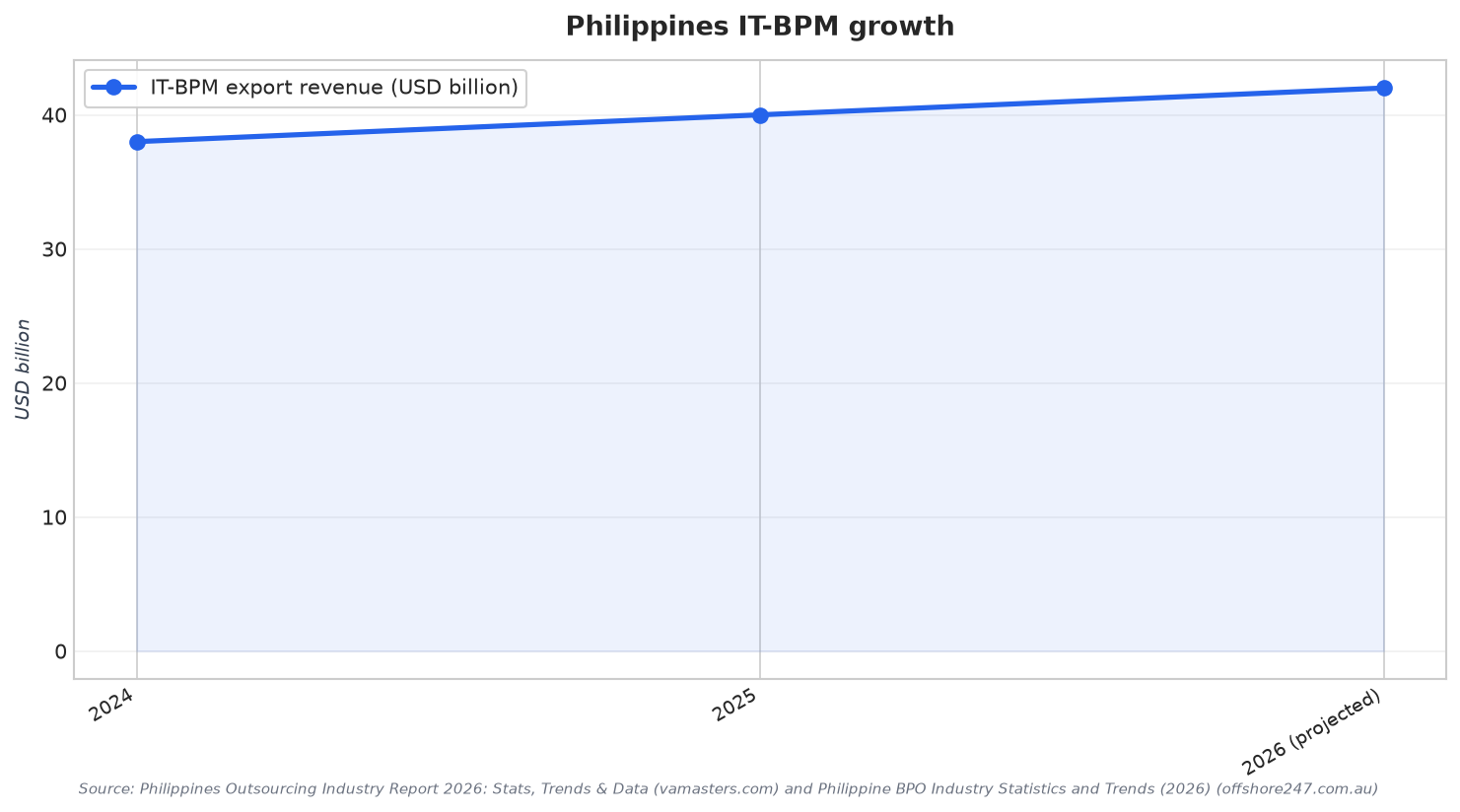
The 2026 outlook continues to anchor that confidence in concrete targets and momentum. One consolidated 2026 report describes approximately $40 billion in export revenues in 2025 with 5% growth, compared with a global outsourcing average of 3%. The same report projects expansion to $42 billion and 1.97 million workers in 2026, while long-term Roadmap 2028 targets sit at $59 billion and 2.5 million workers. These numbers set the stakes for reinvention: the industry needs to protect scale while changing the work mix. That means moving from voice-heavy, routine processing to higher-value services that are harder to automate and easier to defend on outcomes.
AI Is Changing the Job, Not Just the Tooling
AI adoption is now common enough to be measurable, and it is influencing how work gets delivered. One 2026 industry report says 67% of Philippine BPO companies have adopted AI tools, alongside a 67% reduction in training time, from 90 days to 30 days. Another June 2026 update cites CXAP’s 2026 Executive Survey, reporting that 52% of BPO companies in the Philippines are integrating AI technologies and 43% are scaling AI integration across operations. In practical terms, providers are building hybrid delivery models where AI takes routine tasks and human agents handle complex interactions. This pattern supports “workforce transformation” rather than a simple narrative of displacement.
AI is also forcing a strategic repositioning in client conversations. A Manila-focused report describes how AI is pushing Philippine providers beyond cost efficiency and toward measurable customer experience (CX) outcomes, with BPOs moving closer to marketing and customer strategy. That theme is mirrored by another 2026 sourcing overview that notes a structural shift in outsourcing motivations: cost reduction as the primary driver fell from 70% in 2020 to 34% in 2026. The implication is clear for the Philippines BPO industry AI disruption topic: success depends on proving business impact, not just lowering operating expense. Providers that can link service delivery to brand outcomes and customer journeys can defend margins even as automation accelerates.
The reinvention is most visible in specialized vertical work, especially financial services. IMARC Group estimates the Philippines BFSI BPO services market reached USD 590.0 million in 2025 and is projected to reach USD 924.0 million by 2034, with a 4.96% CAGR for 2026–2034. Within BFSI, sources point to AI-enabled work such as fraud detection, compliance monitoring, and data analytics, plus omnichannel support that blends voice with chat and digital platforms. Separate commentary also notes expansion beyond major urban centers as providers add capacity and manage costs. Together, these signals show how “beyond voice” becomes a practical operating model: more channels, more domain depth, and more AI-assisted delivery.
What proves the Philippines’ BPO sector is still growing in 2026?
How widely is AI being adopted by Philippine BPO companies?
Is AI replacing agents or changing their work?
What does the shift from cost to outcomes look like in practice?
How is the Philippines BPO industry AI disruption showing up in BFSI outsourcing?