


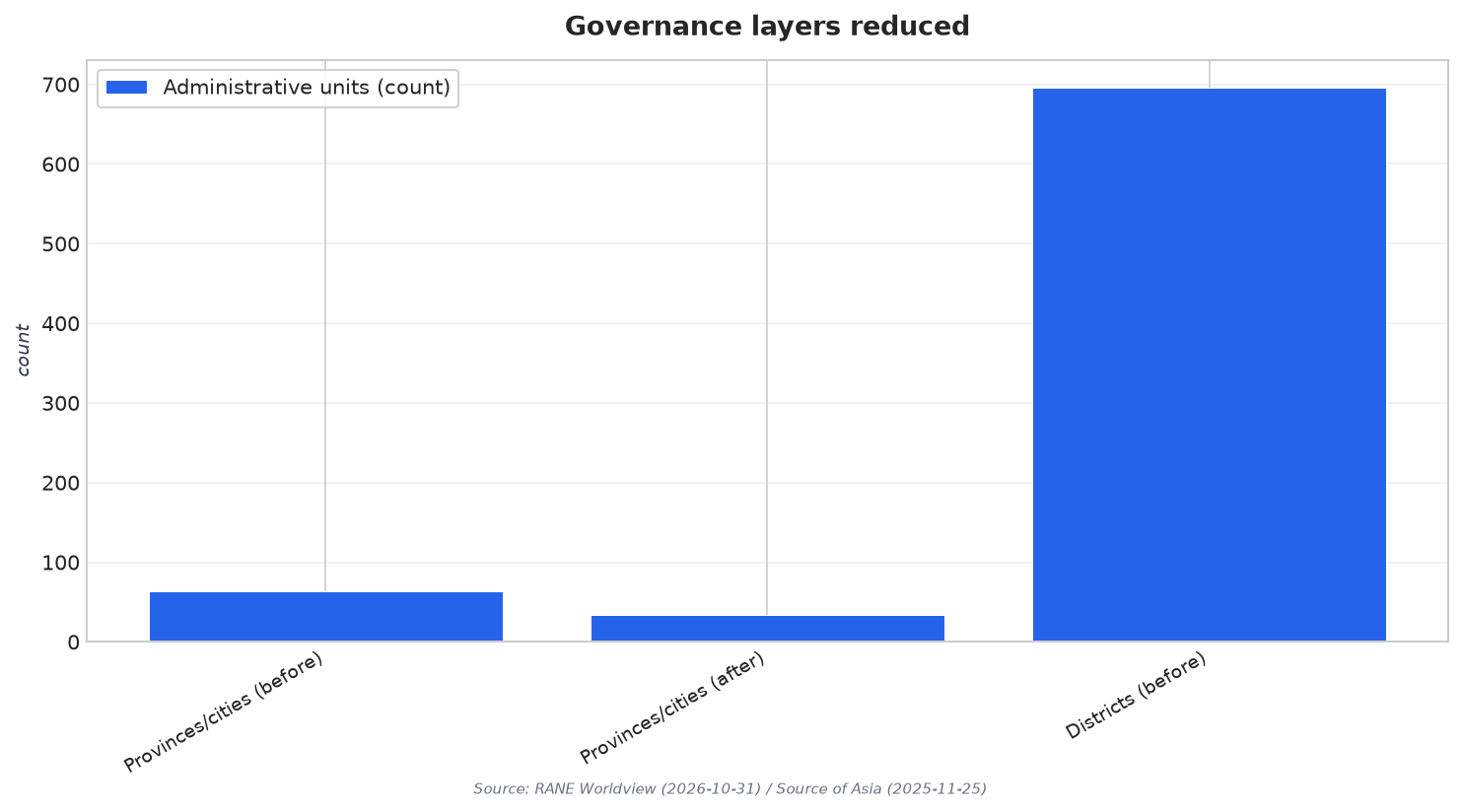
Vietnam’s administrative reset is no longer theoretical for investors planning 2026 decisions. As of July 1, 2025, Vietnam merged 63 provinces and cities into 34 provincial-level units and eliminated the entire district level, removing what had been 696 mid-level jurisdictions between province and commune. A two-tier province–commune structure is now the backbone, with a reported 60–70% reduction in commune-level units under the new model. For foreign businesses, the practical promise is simpler routing for permits and registrations, with fewer handoffs and fewer points where timelines can stall.
Alongside the map redraw, Vietnam issued eight resolutions to reduce regulatory burden and decentralize authority. The package includes plans to eliminate 184 procedures, simplify around 350–394 procedures, and decentralize 134 procedures to local authorities. It also eliminates 890 business conditions and is expected to reduce compliance time and costs by more than 50% compared with 2024 levels. The scope matters for investors because the reforms cover the State Bank of Vietnam and 14 ministries and agencies, including industry and trade, education, healthcare, construction, and finance—areas that frequently intersect with licensing, operational approvals, and ongoing reporting.
What Changes in 2026: Approvals, Oversight, and Where Decisions Land
The administrative direction is not only about cutting steps; it also changes the logic of control. Vietnam is moving away from a pre-approval approach toward post-supervision, giving companies more operating autonomy while strengthening oversight mechanisms. The same reforms aim to reduce the share of procedures handled at the central level to roughly 27%, pushing more implementation responsibility to provincial authorities. For investors, this can translate into faster cycles when local authorities have clear delegated power, but it also raises the importance of understanding how a project’s decision pathway flows through provincial bodies and the remaining central gatekeepers.
Local investment promotion dynamics are already shifting under the 63-to-34 consolidation, according to reporting on government streamlining. The same discussion notes that approvals involving both the Ministry of Planning and Investment and the Ministry of Finance should, in theory, face less inter-ministry friction. However, multiple sources also caution that a restructuring of this scale can bring short-term bureaucratic friction as offices wind down and roles are redefined. Investors should plan for transitional variance across localities even as the national intent is standardization, speed, and a more service-oriented administration.
For deal teams and project sponsors, compliance and sequencing remain decisive in 2026. Vietnam’s Personal Data Protection Law (PDPL) was passed in 2025, with the associated implementing decree in 2026, and was described as moving through an unprecedented rapid approval process. The U.S. Department of State also notes that the prime minister approves eight categories and provincial People’s Committee chairpersons approve 13 categories, underscoring that authority is still tiered and category-based. Land diligence also stays central: the Land Use Rights Certificate (LURC) recording system is maintained at provincial Land Registration Offices, and the same source flags that LURCs can sometimes be issued or amended with administrative error or local transparency issues, creating residual diligence risk even in a streamlined environment.
Investors looking for the “why now” behind the Vietnam provincial merger administrative reform should also read it alongside broader capital-market and policy signals. FTSE Russell confirmed Vietnam’s upgrade from Frontier Market to Secondary Emerging Market in April 2026, effective from September 2026, and expected by FTSE Russell to boost foreign inflows by up to USD 6bn. At the same time, the 14th National Congress that concluded in January 2026 advocated greater focus on project delivery and faster decision-making across ministries and regulators. The net message for 2026 is momentum toward speed—paired with tighter, more formal scrutiny that can surface earlier in the development cycle.
What exactly changed with Vietnam’s province merger?
How many procedures and business conditions are being cut under the 2026 reform package?
How much faster could compliance become compared with 2024?
Where will approvals be handled after decentralization?
How should investors think about the Vietnam provincial merger administrative reform when planning 2026 projects?