

An effective ASEAN go-to-market strategy combines traditional retail, modern trade, and e-commerce with local partnerships, competitive pricing, and reliable supply chains. Companies that depend on a single distribution channel risk missing important customer segments across Southeast Asia's fragmented consumer markets.
According to The New ASEAN Consumer, Eurogroup Consulting's 2023 study produced for the French Foreign Trade Advisors (CCE) APAC Forum, successful market expansion requires companies to adapt their operating models to local consumer behaviour.
The whitepaper recommends a triple-growth engine, stronger local partnerships, and long-term investment in sustainable operations.
For manufacturers, distributors, and business-to-business-to-consumer (B2B2C) companies, these recommendations provide a practical framework for regional growth.
Why Is ASEAN Distribution So Fragmented?
Southeast Asia combines highly developed retail environments with markets where traditional shops, wholesalers, and regional distributors remain essential.
The number of intermediaries between manufacturers and consumers can vary significantly across countries and product categories.
As a result, distribution structures that work in Singapore may be unsuitable for Indonesia, Vietnam, or Cambodia.
Local purchasing habits, infrastructure, retail concentration, and regulatory requirements can affect how products reach customers.
Florian Delmas, President of Andros, describes this complexity in the whitepaper:
"The markets are much more fragmented with more steps and intermediaries in the value chain. This makes business more complex and requires local partnerships who understand the market."
For international companies, effective distribution requires understanding the commercial role of each intermediary rather than simply appointing a national distributor.
The New ASEAN Consumer whitepaper explores why local operating knowledge matters across ASEAN's consumer markets.
The Triple-Growth Engine Behind ASEAN Market Expansion
The whitepaper recommends developing a triple-growth engine that combines traditional trade, modern trade, and e-commerce.
Each channel serves different purchasing behaviours and customer groups.
- Traditional trade: Independent shops, neighbourhood retailers, wholesalers, and informal distribution networks remain important for everyday consumer goods.
- Modern trade: Supermarkets, convenience-store chains, and organised retail support brand visibility, product consistency, and wider customer access.
- E-commerce: Marketplaces, social platforms, and direct digital channels help brands attract customers, compare demand, and support repeat purchases.
Businesses need to understand how these channels interact rather than treating them as separate sales operations.
Digital influence does not necessarily mean that every purchase happens online.
Executives interviewed for the 2023 whitepaper estimated that digital channels represented approximately 20% of total sales activity on average at the time of the research.
This historical observation reinforces the importance of physical distribution alongside digital development.
The challenge is to create a consistent consumer experience while adapting channel investment to local shopping behaviour.
How Should Foreign Companies Choose Local Partners?
Local partners can provide more than access to distributors and retail customers.
They may contribute knowledge of consumer preferences, sourcing requirements, commercial networks, and relevant regulations.
However, the whitepaper recommends looking beyond conventional distribution agreements.
Partnerships may involve joint product development, manufacturing, sourcing, financing, and market-specific marketing.
Andros provides a useful example.
The French food manufacturer has developed local manufacturing hubs across ASEAN markets and sources local ingredients for products adapted to domestic preferences, as described in the 2023 study.
This operating model combines the company's manufacturing expertise with local sourcing and product adaptation.
For businesses assessing partnerships, several questions are particularly important:
- Commercial reach: Can the partner access the intended customers and sales channels?
- Operating capabilities: Does the partner offer relevant manufacturing, distribution, or sourcing expertise?
- Local knowledge: Can the partner explain purchasing behaviour, pricing expectations, and regional differences?
- Strategic alignment: Are both parties committed to a commercially viable long-term relationship?
These considerations matter because a partner with extensive distribution coverage may not necessarily offer the right customer relationships or operational capabilities.
For companies entering unfamiliar markets, B2B market research services can help assess market demand, potential partners, and competing distribution models.
Can Sustainable Supply Chains Remain Competitive on Price?
Sustainability is becoming relevant to consumer expectations, corporate operations, and long-term supply-chain planning.
However, the study identifies a major challenge: many Southeast Asian consumers remain highly price-sensitive.
The whitepaper notes that sustainable products carried effective price premiums reaching approximately 30% in some categories at the time of the study.
Such premiums can limit adoption, particularly where consumers prioritise affordability.
The commercial challenge is therefore to improve environmental performance without making products inaccessible to target customers.
Potential approaches include more efficient sourcing, reduced packaging waste, local manufacturing where economically justified, and improved logistics.
These measures require careful cost analysis.
Sustainability investments should also reflect actual operating conditions and customer demand rather than assuming that consumers will consistently pay higher prices.
For companies developing regional supply chains, the objective is to combine cost competitiveness with operational resilience and measurable environmental improvements.
Where Are the Next ASEAN Market Opportunities?
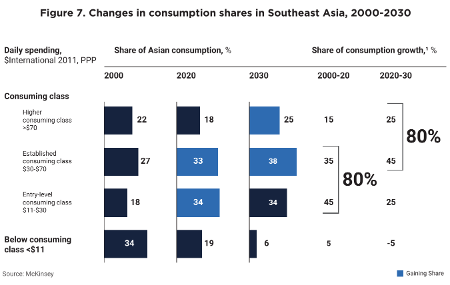
Eurogroup Consulting's 2023 study identifies several sectors with long-term growth potential, including renewable energy, electric vehicles, digital services, tourism, advanced manufacturing, and healthcare.
These opportunities are supported by changes in income, demographics, technology adoption, and consumer expectations.
The study also projected ASEAN consumption could reach approximately US$4.5 trillion by 2030. This remains a projection made in 2023, not a confirmed present-day market figure.
However, market growth alone does not determine commercial success.
Companies must evaluate the specific customers, distribution requirements, and operating conditions of their chosen sector.
A strong market-entry plan should connect market research with clear decisions about partners, pricing, channels, and operational investment.
Businesses planning expansion can contact the B2B Market Research Asia team to discuss market-entry research and partner evaluation.
Frequently Asked Questions
What is an ASEAN go-to-market strategy?
An ASEAN go-to-market strategy defines how a company will reach customers, position products, establish sales channels, and operate across Southeast Asian markets. It should consider local consumer behaviour, competition, pricing, regulation, and distribution structures. Businesses generally need country-specific approaches rather than a single standardised regional model.
What is the triple-growth engine in ASEAN?
The triple-growth engine is a sales approach combining traditional trade, modern trade, and e-commerce. It recognises that consumers purchase products through different channels depending on their location, income, preferences, and product category. Companies should coordinate these channels to improve availability and customer experience.
Why are local partners important for ASEAN market entry?
Local partners can provide access to customers, suppliers, retailers, and market-specific knowledge. They may also support product adaptation, manufacturing, distribution, and commercial operations. However, companies should evaluate partners against actual business requirements instead of selecting them solely for their geographic coverage.
Can sustainable consumer products compete on price in ASEAN?
Sustainable products can compete when their benefits and pricing align with customer expectations. However, higher production or sourcing costs may limit adoption in price-sensitive segments. Companies should evaluate ways to improve supply-chain efficiency, reduce waste, and deliver meaningful product value without depending exclusively on premium pricing.
Which sectors offer opportunities for ASEAN expansion?
The 2023 Eurogroup Consulting study identified opportunities in renewable energy, electric vehicles, digital services, tourism, advanced manufacturing, and healthcare. Their attractiveness varies by country and business model. Companies should validate current demand, competitive conditions, regulations, and partner capabilities before committing resources.
Build a Stronger ASEAN Market Entry Strategy
Southeast Asia offers significant opportunities for manufacturers and B2B2C companies, but success depends on more than product demand and distribution agreements.
For executives assessing regional expansion, The New ASEAN Consumer provides deeper analysis of consumer trends, distribution challenges, local partnerships, and practical recommendations for sustainable growth.