
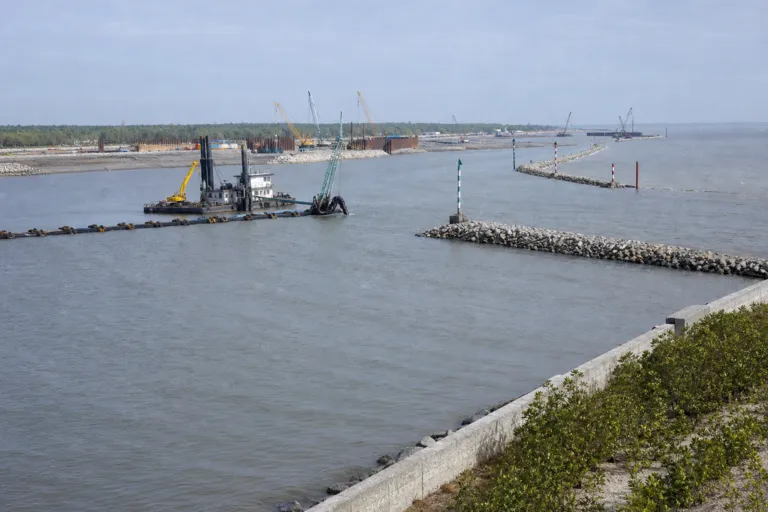
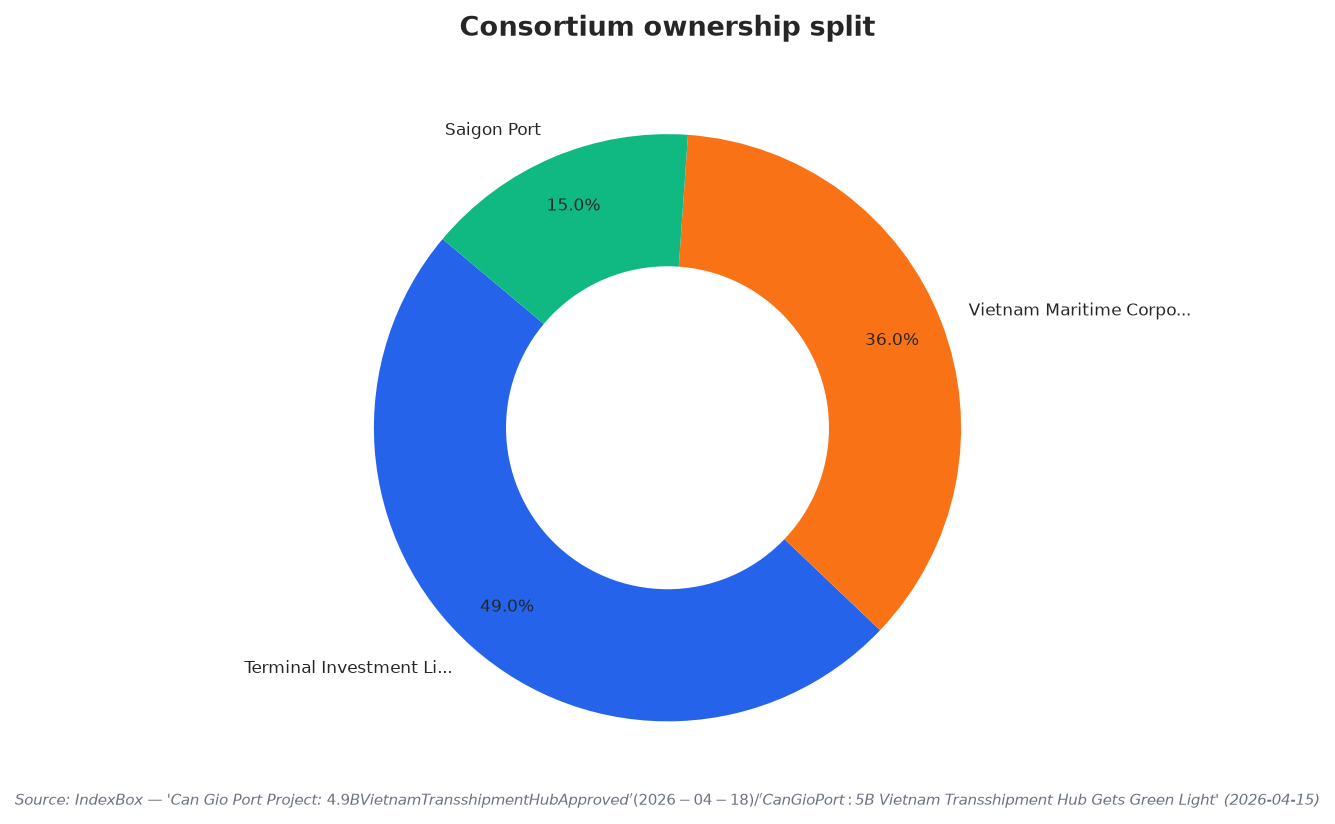
Vietnam’s Can Gio project is being framed as a new international transit gateway near Ho Chi Minh City, with a specific focus on transshipment rather than only domestic throughput. Multiple reports describe an investment in the $4.9 billion to about $5 billion range, including figures of VND128.872 trillion (US$4.9 billion) and VND128,872 billion (close to US$5 billion). The development site is described as roughly 570–571 hectares on an offshore islet or Go Con Cho Islet at the mouth of the Cai Mep River. The approved consortium structure is consistent across sources: Terminal Investment Limited (TIL) at 49%, Vietnam Maritime Corporation (VIMC) at 36%, and Saigon Port (a VIMC subsidiary) at 15%.
The 2026 story is also about timing discipline, not just ambition. One source says Ho Chi Minh City would officially commence construction on April 30, 2026. Another explains that, as of August 2026, the investor consortium had been approved in April 2026 and had formed a joint venture company, but construction had not begun on site. That same update notes city leadership pointed to Q4 2026 as a possible start if procedures are completed, describing it as a target rather than a confirmed date. In parallel, the watch points include whether construction starts by late 2026 or early 2027, and whether shipping lines commit to mainline calls ahead of the first-phase target.
Capacity, Berths, and the Long Game to 2030 and Beyond
The port plan is set out in clear milestones. Sources cite an initial capacity target of 4.8 million TEU by 2030, paired with a long-term goal of 16.9 million TEU by 2047. The first phase is described as up to four berths capable of accommodating vessels weighing up to 250,000 tons, while the ultimate build-out envisions 13 berths and a total quay length of 7.5 kilometers; VnExpress also describes the main quay as stretching 7.5 km. This is presented as a multi-decade development, with one report describing a build timeline anticipated to take two decades, followed by a lengthy operational period.
What makes the Vietnam Can Gio transshipment port narrative distinctive is the strategic “relay hub” framing. One explanation distinguishes two models: a Vietnam-centered transshipment approach consolidating southern Vietnamese export and import cargo at Can Gio, and a broader regional relay model transferring cargo between China, Vietnam, Cambodia, Thailand, Malaysia, Indonesia, and long-haul markets. The same source calls the Vietnam-centered model “more defensible,” while still noting the project could capture some Vietnam-bound container traffic now routed through Singapore. For some buyers and importers sourcing from southern Vietnam, that shift is positioned as a pathway to more direct sailings and lower feeder costs, even while tariffs and origin rules remain central to landed cost.
Local impact claims are also central to the pitch. Once fully operational, Can Gio Port is expected to contribute between 34,000 and 40,000 billion VND to the state budget annually, and separate reporting projects VND34–40 trillion ($1.29–$1.52 billion) in annual revenue at full design capacity. The same sources cite 6,000 to 8,000 direct jobs, alongside “tens of thousands” of indirect ones. The project also expands the footprint of MSC-linked operators in Vietnam: MSC is described as operating within the Cai Mep port cluster and handling over one million TEU of Vietnamese cargo annually. In that context, Can Gio is portrayed as both a national gateway and an international transshipment hub, with surrounding development plans in Can Gio and new transport connections mentioned as part of the broader push.
Who is developing the Can Gio International Transshipment Port, and what are the ownership shares?
What capacity is Can Gio targeting by 2030, and what is the longer-term goal?
How many berths and how much quay length are planned for Can Gio at full build-out?
What is the latest described construction status for the Vietnam Can Gio transshipment port in 2026?
What economic and employment impacts are projected once Can Gio is fully operational?