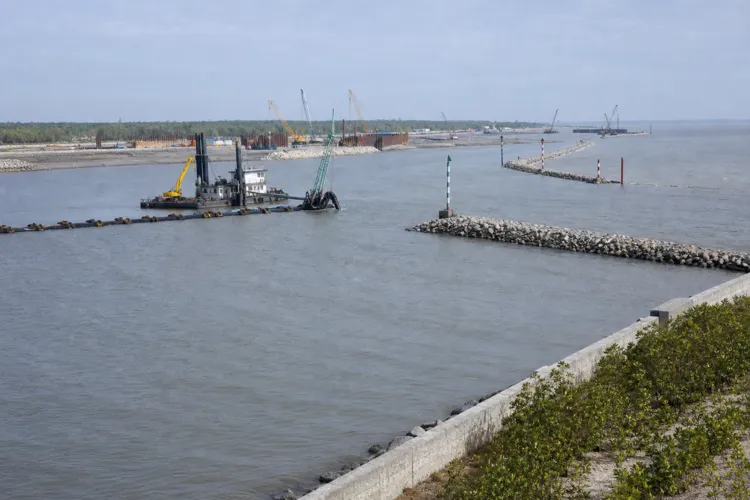

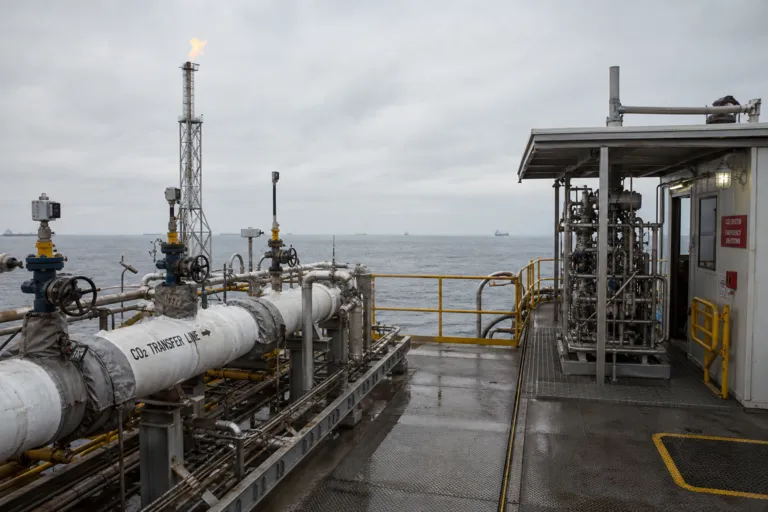
In 2026, Southeast Asia’s CO2 infrastructure race is becoming visible in steel and seabed surveys. An analysis in Pipeline Technology Journal describes subsea pipelines taking shape off Borneo and the shores of Java, built to move captured carbon dioxide for permanent storage rather than oil or gas. Some planned links stretch more than 100 kilometers, and the contest is framed as a direct rivalry between Malaysia and Indonesia to become the region’s premier storage destination. The same analysis notes that industrial emitters from Japan, South Korea, and Singapore are already being drawn in because they lack suitable geology of their own, making cross-border transport and shared storage hubs central to near-term CCS deployment.
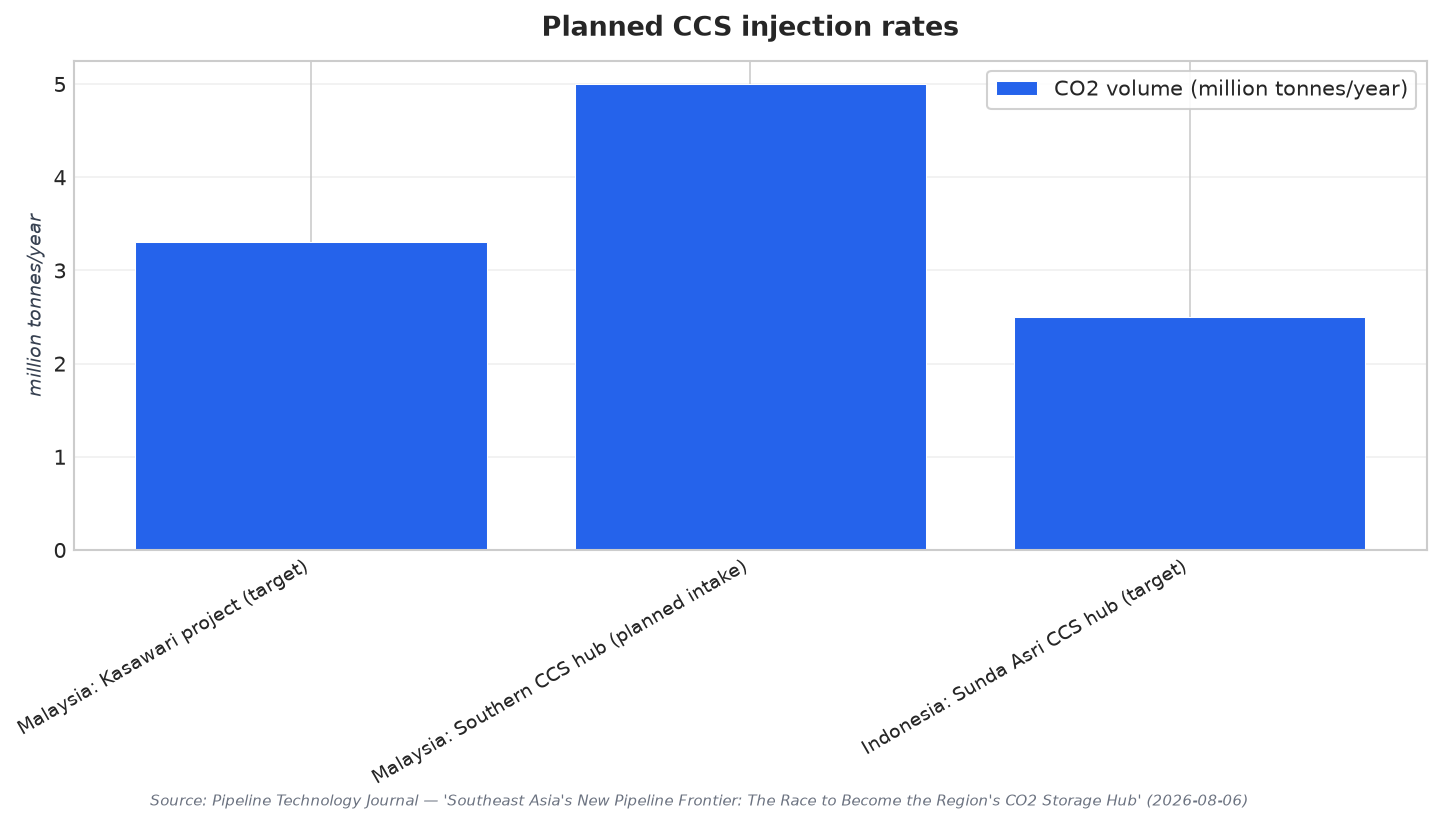
Malaysia’s most concrete near-term signal is Petronas’ Kasawari development. The project is described as one of the world’s largest planned offshore CCS facilities, built around high-CO2 gas processing and a dedicated subsea export line for captured carbon. Project details cited by Pipeline Technology Journal specify a 138-kilometer, 16-inch subsea pipeline that would move CO2 to the depleted M1 reservoir for permanent injection, with a target of 3.3 million tonnes per year. After gas production began in 2024, Petronas pushed to accelerate first injection toward 2027, earlier than previous 2029–2030 estimates, to narrow the timing gap between emissions and sequestration.
Southern Hub Strategy: Imported CO2, Shared Infrastructure, and Timing
Alongside Kasawari, Malaysia is advancing a multi-user pathway built around the Duyong field off Peninsular Malaysia. Petronas, TotalEnergies, and Mitsui are developing a Southern CCS hub intended to receive liquefied CO2 shipped from Japanese industrial clusters—up to 5 million tonnes annually—before injection, according to Pipeline Technology Journal. Front-end engineering is under way following Malaysia’s first offshore CCS assessment permit under the new CCUS Act 2025. Timelines vary by source: the journal cites a final investment decision targeted for late 2027 with operations eyed for the end of the decade, while MK reports Petronas plans an FID as early as 2028, targeting completion in 2030 and injection beginning as early as 2031.
The cross-border proposition rests on geology, data, and logistics, not just marketing. MK notes Malaysia’s depleted offshore gas fields can be repurposed for storage and highlights Petronas’ extensive geological and reservoir data from decades of exploration to assess containment and long-term stability. It also points to Malaysia being outside the main areas of the Pacific Ring of Fire, with many promising reservoirs located at least 2,000 meters below the seabed. On capacity, MK cites Global CCS Institute hydrocarbon basin assessments estimating Malaysia’s CO2 storage potential at about 13.3 billion tonnes, with around 2.4 billion tonnes across depleted oil and gas fields and saline aquifers having undergone verification and due diligence.
Malaysia’s pitch is also sharpened by regional competition and global CCS project signals. Indonesia is building its own multi-user offer, including the Sunda Asri concept offshore West Java with a 180-kilometer pipeline and first injection targeted at 2.5 million tonnes per year by 2030, plus a rule allowing up to 30% of storage capacity for imported CO2, according to Pipeline Technology Journal. Globally, the Global CCS Institute’s 2026 status update says 15 projects are operating and 21 are under construction, while cross-border agreements, CO2 shipping, and planned pipeline networks are improving connectivity between emitters and storage. In that context, Malaysia’s hub model is explicitly designed to serve regional hard-to-abate industries—an approach MK suggests could underpin a “CCS-as-a-Service” business combining transport and storage for customers that cannot secure their own sites.
What is driving interest in Malaysia as a regional CO2 storage destination in 2026?
What are the key numbers behind Petronas’ Kasawari CCS plan?
How much imported CO2 could Malaysia’s Southern hub be designed to receive?
How large is the storage resource discussed for a Malaysia carbon capture storage hub?
How does Indonesia’s hub push compare with Malaysia’s cross-border strategy?